





Pizza may not be the delivery meal it once was, but one player is still dominating, according to an industry analyst.
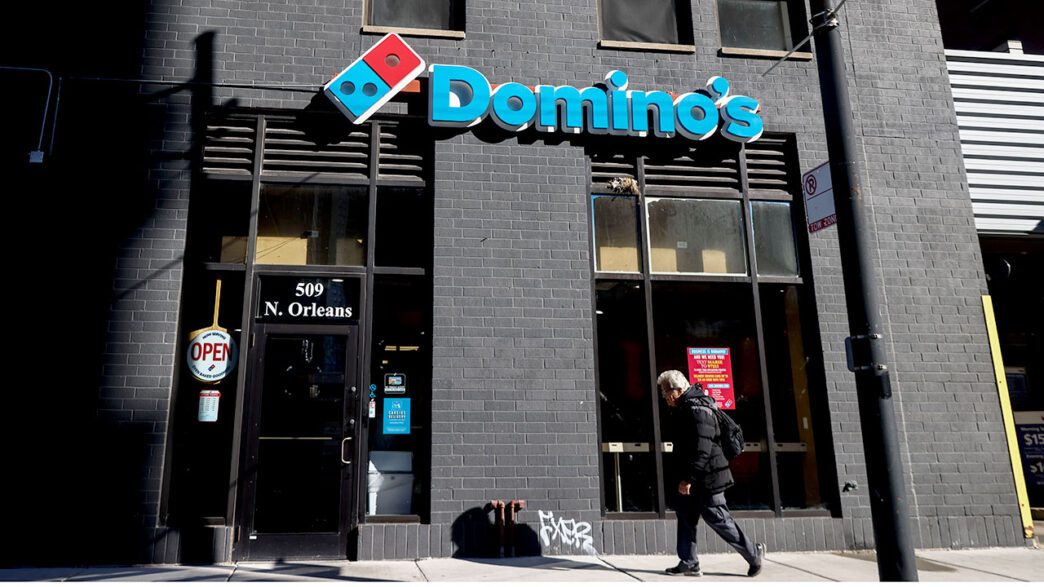
The pizza industry is facing intensifying competition, not just from other cuisines, but from within its own category. Still, Domino’s has “regained its crown” in the past two years, Sara Senatore, Bank of America Securities senior restaurant analyst, told FOX Business.
But it isn’t because people fell in love with pizza more. The company’s strong focus on value, marketing scale, technology and loyalty under CEO Russell Weiner gave Domino’s a competitive edge, according to Senatore. 
DOMINO’S REBRANDS FOR FIRST TIME IN OVER A DECADE
“If Domino’s is going to outpace the industry meaningfully, which it is… that share has to come from somewhere else,” she said. “And that is presumably coming from Papa John’s and Pizza Hut among other restaurants.”
Domino’s launched a partnership with DoorDash this year, opening an entirely new channel of distribution for the company. While it has helped the pizza chain compete, it’s not the sole reason why it is thriving, Senatore said.
DOMINO’S PIZZA DEBUTS STUFFED CRUST IN EFFORT TO BOOST SALES
For one, the pizza chain, which rebranded in October for the first time in a decade, has been hyper-focused on its value proposition, including an enhanced loyalty program, and its advertising strategy, Senatore said.
“They’re being very sharp on value and they’re very strategic about what they advertise, how they advertise. And they’re really leveraging the fact that they have this huge advertising budget – it’s like four times or more the size of their nearest competitors,” said Senatore.
The company also lowered the entry cost of joining its loyalty program by adding more tiers and making it easier for customers to redeem points.
KFC BRINGS BACK A TASTE OF NOSTALGIA WITH FAN-FAVORITE ITEM
“There’s this sort of virtuous cycle where Domino’s accumulates users on their loyalty program and then that makes it easier for them to market directly to those consumers,” Senatore said, noting that the better a company does with loyalty, the more customers it has and the more effective its loyalty program becomes.
This in particular helped the company’s resurgence, according to Senatore.
Sales at Domino’s U.S. locations grew 5.2% year over year in the third fiscal quarter. Comparatively, sales at Papa Johns North America stores fell 3% and sales at Pizza Hut U.S. stores declined 6% in the same period. Little Caesars, another competitor, is a privately held company and does not publicly report earnings.
Domino’s growth stands out because the category remains slow-growing and increasingly competitive.
“There’s certainly more competition for the pizza delivery dollar, if you will. So that’s where I think even if you think that the pizza category is growing at roughly the same pace as it always has, there’s certain more competition within that category,” Senatore said.
GET FOX BUSINESS ON THE GO BY CLICKING HERE
Mark Wasilefsky, head of restaurant and franchise finance at TD Bank, said the pressures facing the pizza industry have intensified in recent years, driven both by competition within the category and broader shifts across the food sector.
“Given the small amount of space and relatively simple equipment requirements, pizza has some of the lowest barriers to entry of any cuisine, making small local shops easy to set up and creating more ongoing competition,” he said.
But he also pointed to sweeping changes across the entire restaurant industry that he said have fundamentally altered the category’s economics.
“For decades, the pizza business model was built on the foundational monopoly on delivery that they had. With the exception of some Asian cuisine, pizza was the only scaled option delivered right to the consumer,” Wasilefsky said, adding that “this was so ingrained into the industry that operators not only had their own drivers, but many had a significant capital investment in fleet vehicles with some even customized just for the delivery of pizza.”
This hinted at “how healthy margins were” at that point, he added. But things drastically changed during the pandemic when the adoption of mobile ordering and the rise of third-party delivery apps was supercharged.
“Pizza has forever lost this basic tenant of their business model, and they have yet to recover,” he said.